

One year ago, the Washington Post had me on WP Live to talk about skill and the workforce. I recommend this 30-second-ish snippet that distills the motivation for this post (video is terrible, what can you do).
There’s a dirty little secret about corporate training: it’s never worked.
Firms spend hundreds of billions every year across a dizzying range of desired skills, from compliance (e.g., phishing, sexual harassment) to software (e.g., CAD modeling, typescript) to the “soft” (e.g., leadership, sales, service) and far, far beyond. I cut my teeth in the L&D industry in my early 20s, and around then every firm selling training for knowledge workers woke up to the need to prove “business results”. Why? Because the data had been in for almost a lifetime: we rarely measure the behaviors associated with training (it’s costly to do) and when we do training doesn’t move the needle. That results rallying cry didn’t have an effect on outcomes, either. When you poked under the hood, changes in behavior couldn’t be causally linked to training as separate from the skill development that comes just from doing the real job, under pressure.
Every L&D leader in every corporation I talk to knows this. Admits it freely. So does every leader with a P&L. About 20 years ago research settled this question, and it keeps relitigating it with each new learning paradigm. Same result. And yet: firms still spend their money on training as if it caused results. To be charitable, it’s important to say that firms that offer training do a better job retaining employees, and report better work climates. So it could be that the training spend is worth it for these secondary outcomes. And I believe that without it, many workers couldn’t even attempt certain work, practically and legally.
But if we’re looking to cultivate the ability to reliably perform a task under pressure (my definition of skill - on display in my 2024 book "The Skill Code"), training is, at best, table stakes: it helps you understand the game well enough to step on the field. The “at best” is doing a ton of work there, by the way. The research on learning and teaching makes it very clear that a healthy chunk of training is likely to both demotivate trainees and limit their ability to build skill on the job. I can attest to this - I taught thousands of leaders best-in-class (that is to say fragile, rigid) frameworks for how to lead, and many would show back up to work and act like robots until their coworkers either ducked and covered or shook them out of the trance. One in perhaps ten leaders “got it” and created value by adapting the framework. Trust = degraded. Want to bet your job that doesn’t dent the bottom line?
Neither would I.
L&D professionals and leaders take that bet every day. We still train people to do all kinds of things that are core to knowledge work: Collaboration. Project management. Communication. Software engineering. Performance management. And, these days…
We are wasting unprecedented resources on AI training

So - everyone’s getting AI training, and has been for one or two years. How much did that cost? Nobody tracks it officially - I had to build the number: about $400 billion a year (depending on whose market sizing you trust), and US firms spent $102.8 billion. AI training looks to be in the low-to-high single digits of percent: that same survey ranks AI the second-fastest-growing line in the training budget, with AI tool use in L&D jumping from a quarter of firms to better than a third in one year. Three to eight percent off that? $10 to $30 billion worldwide. From the other direction: BCG finds companies spending about 1.7 percent of revenue on AI this year, double last year's, and pouring a large share of it into people: a quarter of the AI budget at cautious firms, up to sixty percent at the aggressive ones, goes to upskilling and retraining. Extrapolate that and you land in the same tens of billions.
What has all this sheep-dip AI training gotten us? Familiarization? Sure. Ask a CTO what effect that had: Logins? Nope. That took fiat. Daily use? Nah. Fiat. Token burn? Same deal. I bet you agree, don’t you? Ask around. Does anyone disagree? An increasing chorus of executives are with us, in fact. Wharton’s excellent 2025 AI report shows that confidence in training as the path to AI fluency fell 14 points and overall training spend went down 8 points. At the same time “we’ll just hire new talent instead” went up by 8 points. A clear and growing vote of no-confidence in training. There are notable and wondrous apparent exceptions, like the Netflix structure that Steve Yegge told us all about recently. But if you peek under the hood, that’s much less training than it is a series of hackathons with public accountability. That’s… structured work. More on that later.
To walk this back a bit, some level of AI familiarization is obviously critical. So I’ll give you a giant, unwarranted freebie and say we had to bear a significant chunk of that $20-ish billion dollar burden. Until today. Everyone knows what a chat interface is now, knows how to open copilot, knows AI makes stuff up, and is off vibing their memos while looking for the fabled “use case” that will make AI valuable. In a small percentage of cases folks are using harnesses like codex or claude code to do some semi-autonomous work. Burning some tokens. And in the software domain, engineers got some workshops and are quite aggressively using multi-agent setups, shipping more PRs than ever. How much of that has translated into business results? Azeem Azhar’s latest report cites the Oliver Wyman Forum: only 27% of executives say AI has met their ROI expectations. The Wharton report skewed more positive, claiming 72% track ROI and 74% see positive returns. But none of these are talking about training. They’re talking about the AI licenses themselves, and often building products or internal systems that use API calls to automate data processing. These are dollars shoveled to Anthropic or OpenAI, and often don’t involve training employees on use of chat or harness-based AI at all. Pretty damming that Claude and I couldn’t find even one formal mention of training dollars as related to AI ROI.
…and it’s getting worse: AI training has growing, negative ROI
I’ll go where you already likely were: AI itself is the problem here. Let me give you one of a few charts I use to remind folks of the cost/capability curve:
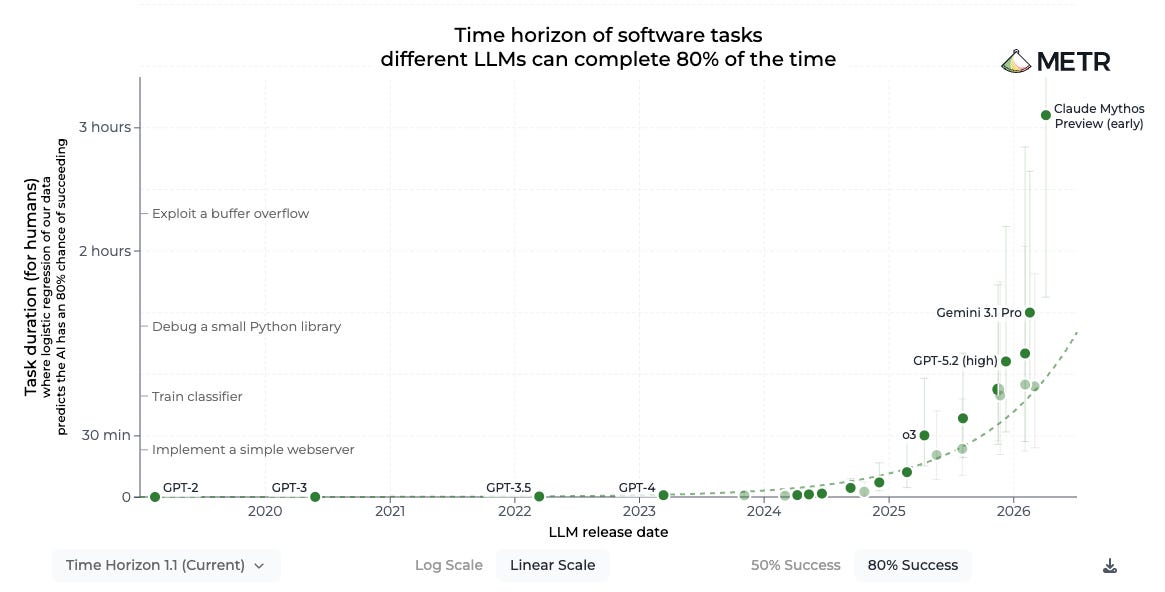
I’m on record as one of the more critical-yet-AI-pilled reviewers of the METR findings. But the coherence amongst the diverse chorus of evaluations, metrics, and prediction markets all indicate that the half life of any particular model is short and shrinking, the power they deliver per dollar is huge and exploding, and that’s to say nothing of the user experience. We’ve gotten claude code, claude cowork, codex, and a weekly shot in the arm of features within each - have you tried claude/tag? /goal? The new “record” feature in Codex? Then of course there are skills - not the kind of skill you and I have, but a standardized approach to capturing repeated model behaviors in a markdown file and tucking it into your local setup so your model (and you, ideally) gets more capable and reliable. Tried Superpowers? You know what a skill is.
So whatever formal training you went through on AI, if it was last week it’s out of date. I’d guess I burn a minimum of 5% of my time a day keeping up. Then come two day intensives when a logjam of new capability collides with an irritation or an idea, and I burn 40% of my day building, testing a new thing while trying out the new stuff. My latest - just over the last three days - is a system that I call Understudy that learns its way to writing in my voice by studying the edits I make to Claude’s outputs.
For the past six months or so I built and delivered an experience to corporate teams on using AI to improve work processes. I’ve run these for over 40 companies, perhaps 2500 people, and in each session I ask them: what AI did you have, what training did you get, what do you use AI for, and what do you think of it?
Most of those teams are on copilot. The Microsoft app that has a model picker - you know the one:
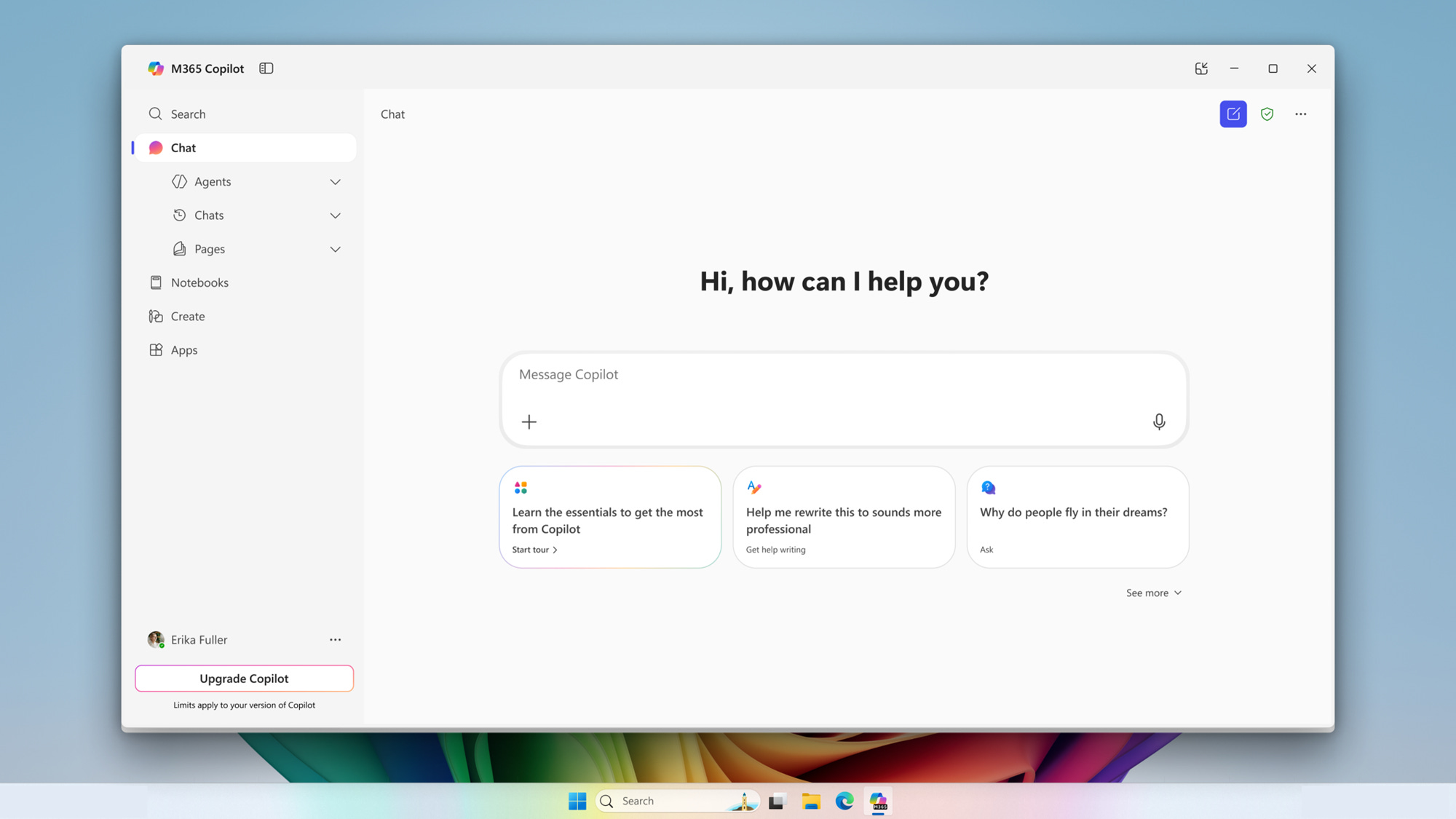
The last time those teams got AI awareness training was about a year ago. At best, nine months. NINE MONTHS! Haven’t heard anything since, let alone gone and looked for it. Back then they went to copilot to “try to be more productive”, asked a question, (forgot that the model picker was on “auto”, which meant they were getting lower-grade intelligence - basically polling a nerdy, highly-caffeinated high schooler) got a result that was kind of good, kind of sloppy, they fixed and sent it and they… stayed put there. Memos galore, done. That’s their AI for the day, and they keep at it for the next nine months. Others are intentionally less active. Their take? Flavor of the month, same as it ever was in big companies. Just duck and cover and it’ll all blow over. A few protest. For these folks, keystrokes are now theft and surveillance in one, and/or using AI means dumbing themselves down.
This is because of their training. It anchored them on what was possible - both in terms of the underlying capability and the user interface.
To keep up, you have to regularly break your mind on this stuff by accomplishing impossible work in tiny amounts of time. That’s it. That’s the only way. I wrote the piece in that link in 2024, by the way. Most of us simply didn’t do that. And most of us are the ones determining how AI is used, deciding if it’s safe, effective, or helpful, and talking about it over the kitchen table. Which means another of my concerns - one that spans back to 2015 when I found it first in robotic surgery - is also coming to pass: the specter of skills inequality. Those who can, are doing, and those who don’t work out in this sense are just increasingly underequipped.
So AI training for garden-variety knowledge workers isn’t just dead - it’s necrotic - likely to anchor the participant in what’s possible today, zombifying them for the race tomorrow. Making self-serve training content - no matter how modular, engaging, or bite-sized - takes months, and model releases come every week or so. The more that spacetime stretches, the more harmful and wasteful that content becomes. A theme I’ll come back to later: this doesn’t just apply to training. Anything you plan at meat speed - a reorg, a six-month consulting engagement - is stale before the deck renders.
Give me a break, Matt

Okay, okay. You’re a professional. You’ve been around the block. You might even be a seasoned L&D leader who understands the imperative for business results, knows instructional design and learning science, and who works at a well-run company. So you might well be thinking I’m taking cheap shots at this point. “You’re just talking about bad training, Matt. Good training is effective!”
I think we’re on a lot of shared ground on this one, so let me give this argument as much oxygen as I can. Let’s flick back to Steve Yegge’s Netflix example to flesh this out. Quick reminder: he’s one of a few that have taught us how quickly the world is changing, and how important it is to build skill with AI. He passed along the best bootcamp he could find.
Steve tells us that at Netflix, Ezra Savard set up experiences for teams of five to ten people, including their manager. Everyone brings their actual work, spends five hours hacking at it with an instructor who burns more than 15m tokens a day regularly, and trainees bump up an electron shell to 5m tokens a day, and stay there. Then, another experience like that and they can do 15m. The experience reliably bumps what you can do with agentic software development. The intensity is required, by the way: shorter sessions, bigger audiences, opt-in at the individual level - none of that was effective. Oh and before each session, each participant has to have basic familiarity, so let’s say they watched some videos: internally produced or sourced externally and curated for the effort.
This is the hands-on-keyboard, do-real-work-with-accountability model, and calling this a “workshop” is probably more appropriate than training. But I’ll even let that slide. Let’s call this great training.
This is decidedly unstale and highly effective for the folks involved. And also radically insufficient.
First off, you need a frontier-fluent human in the room. There are almost none of them, statistically speaking. To scale this, you’d have to clone them. Illegal, whoops. So you preach to the converted, and the AI capability gap in your organization yawns wider. Second: this is an event, and AI is an event every day. Workshops run in “meat time” and AI runs in transistor time. For instance after learning to spend 15m tokens a day, you have to come back to learn to spend them efficiently. You’re setting yourself up for a workshop treadmill. Third: it’s still not the work. Five hours with real accountability and tasks is amazing, but it’s a far cry from Tuesday. Keeping the momentum going - socially and technically - takes ongoing experimentation, communication, motivation, contextualizing your learning… you quickly realize that real skill development has to be cultivated in the day to day doing of the job and organizational change management or your 15m token count is going to curdle into expensive slop. Fourth: it is still one size fits all. Each person arriving to that workshop has different needs, experience, skill, goals, and tasks. They will afterwards. All it takes is a quick flick back to Bloom’s two-sigma paper to remember that everyone in the room pays a hefty toll for settings and experience design that cover them as a group. Fifth - and perhaps most on brand for me - it doesn’t touch the “occupational rot” in the firm. It does nothing for the novices who are cut out of the action, so you end up with a network that stays bottlenecked even as its nodes speed up. Population-level skill development is perhaps even more at risk because participants will need novices - and each other - less and less over time.
Think about this like an AI-informed CFO for a second: one internally-staffed team-session is maybe eight to ten grand (5% of that is tokens). Lifting a 12,000-person workforce runs twenty-seven million, then fifteen million a year forever, gated on seventeen frontier instructors who are either too busy or don’t exist. And speeding nodes up isn’t the deep ROI problem - seeing and modding the network is. That’s a topic for another day.
Let me be very clear. I think the Netflix model is amazing. But Steve and I are on the same page: it’s not the finish line. People, teams, occupations and companies cannot operate in meat time anymore. It’s self-injurious behavior that feels like best practice.
What to do instead
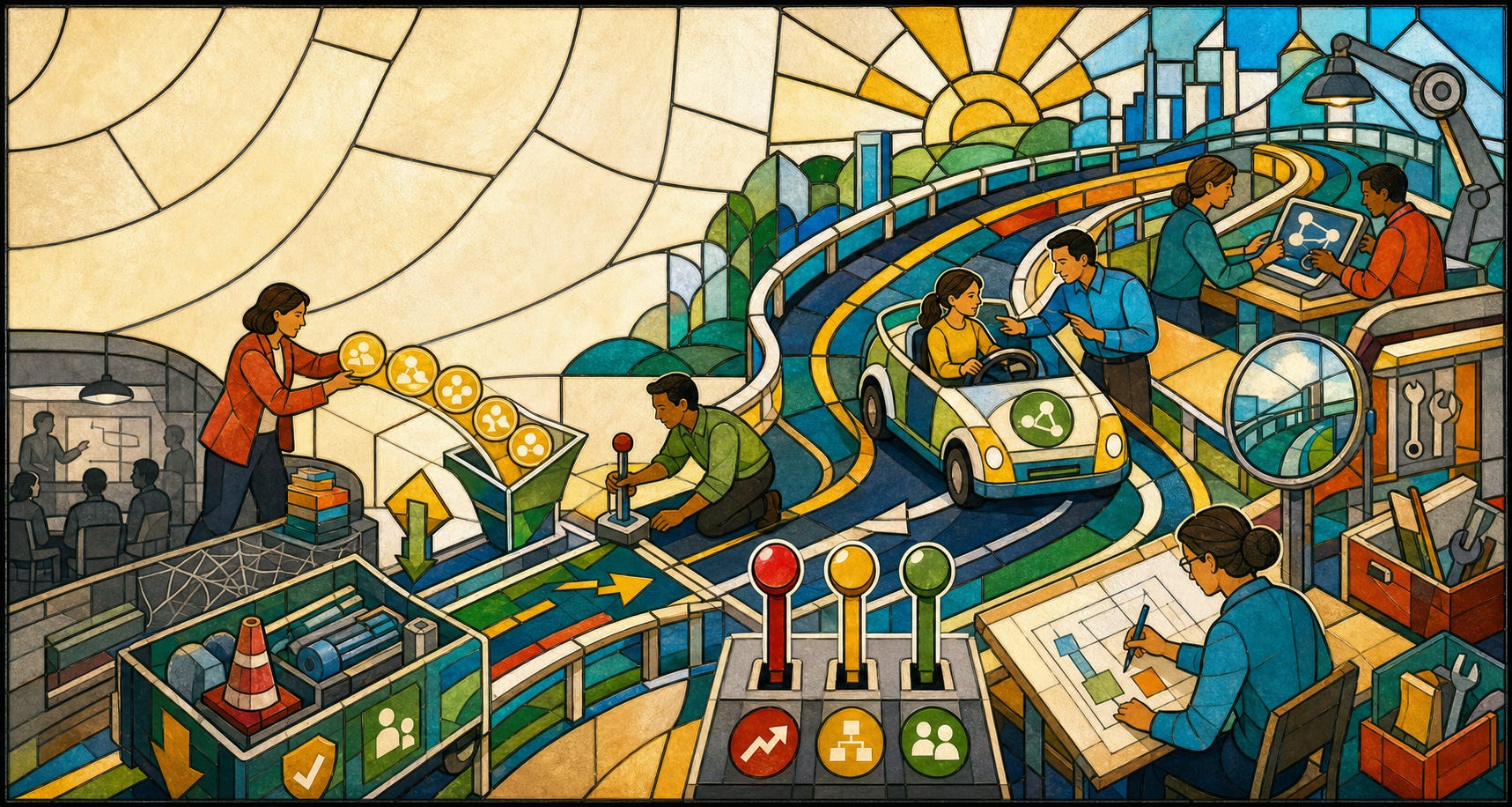
Have a multimillion dollar budget for training? Your first step is to set aside at least half of it for something else: work redesign. This goes way beyond AI training. This is about your entire budget. In March of 2025 I laid out the case for this in TD Magazine (the flagship publication for the Association for Talent Development, the world’s leading organization for training and learning - kudos to ATD’s President Tony Bingham for inviting me to write a deep reconsideration of their core mission).
tl;dr? Your employees are rewriting the org out from underneath you by doing more of the work with AI. The transformation you’ve got scheduled for Q3 will clash with the one that’s already underway, growing chat-by-chat, agentic run by agentic run. This could be great for short-run productivity, but is quite bad for the novice trying to learn how to do the work - they’re optional now, so don’t get to participate. That’s how we actually build skill.
To manage this, firms need to redesign the work to maintain a healthy mix of Challenge, Complexity, and Connection - literally the “Skill Code” in my book - while also insisting on productivity gains. We can have both, it’s just harder to do. The status quo will drive us towards less learning by doing both in the short run because novices don’t get a turn at bat - but also in the longer term because default use will carve new routines for work that formalize this deal. Expertise-breaking work will become standard operating procedure! You have to take proactive steps to ensure that just by doing their jobs, employees will get better at them. No time away from it, no extra clicks, or systems. Road design is mostly what makes people drive safely and get better, not driving courses. Work is the same.
But the technology has to change, too. Car design is the companion to road design when it comes to encouraging safer, more effective driving - and improvement on those things over time. Unfortunately we can’t count on model providers to address the learning risks of their systems. They’re too focused on existential risks like bioterrorism and political manipulation (thank you!). Sure, they ship occasional features that address skill development, but these are sideshows to shipping more IQ. And who would trust the maker of an unregulated performance-enhancing drug to tell you how to use it safely and effectively? I’ve interviewed dozens of software engineers - the bellwether for knowledge workers - on this one, and have scraped reddit for their chatter: they do not trust model makers’ efficiency metrics. So model makers are not coming to save our skills - they couldn’t even if they wanted to.
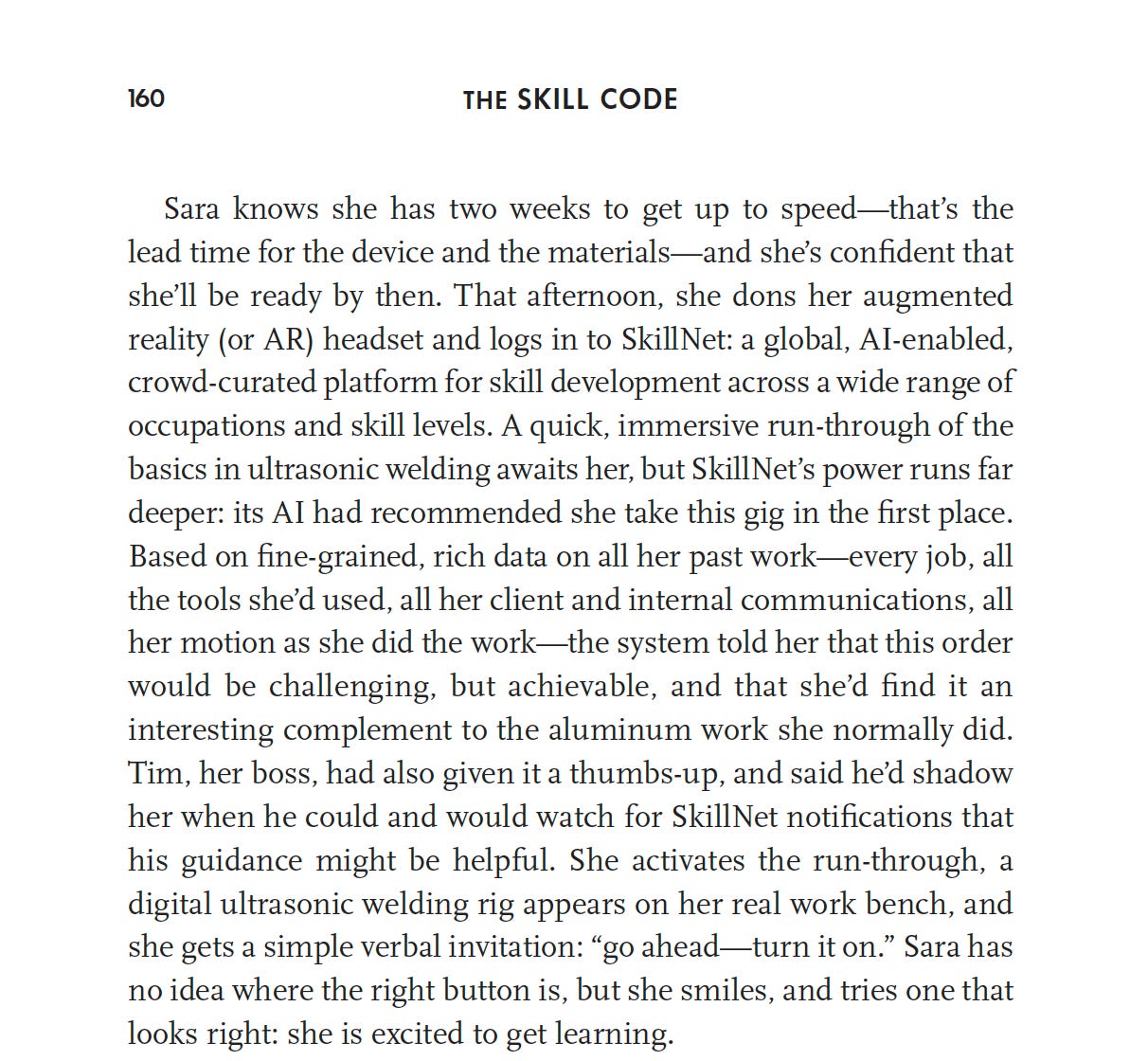
So now we have no choice to do anything other than build and use the system I talked about in the last chapter of my book (I wrote this in October of 2023):

On the next page, I called this “SkillNet”: a “global, AI-enabled, crowd-curated platform for skill development across a wide range of occupations and skill levels”. Hate to self-quote twice, but it’s worth it to lay out the vision:
So, concretely, what needs to be built to make this vision come true? For learning at the speed of work? You’d need a matching system that could sense the real world goals, prior skills and work history for each worker, a well-decomposed view of the work available out there in the world, agents actively scouring all that to make work-based matches, and highly modularized instructional material that could be automatically customized for each person, just in time to support their work. Something that did this, by the way, would mean workers taking steps - with dopamine coursing through their veins - towards tasks that complement the AI they currently rely on. It would drive them towards more warm, trusting relationships with each other because that’s literally required for healthy skill development. And it would have to balance the needs of workers and the firm - both need to win. You’d probably need a lot more than I could imagine in 2023, actually, but you would trust the intuition that it’s all possible.
If you’ve been following me all along - caught the Ted talk, read my book, noticed that I went dark on substack in July of 2024 - you might be thinking “right, Beane, so… what? What else you got? Where you been for two years?”
Tomorrow is the first day of my academic leave, and you’re about to find out.
Excellent article! Thanks for speaking the unspoken!