


It’s been two years since I put down my substack pen. My last post in 2024 - “Measure Twice, Spend Once” - was a bit of a manifesto: we can use AI to measure our work in new ways, and we need to figure out how to use AI! The twist was the same call-to-arms I’ve been issuing since about 2015: default approaches to intelligent automation will get a productivity boost at the expense of skill development, and this will hamstring careers, organizations and possibly the economy. Trillion-dollar problem. So I said we needed to use AI to measure productivity and skill development before we can get satisfactory ROI on AI. I said we needed a ruler.
I went silent because it was time to build it.
Now I’m back for a three-part series to flesh out the problem space, describe what a solution would have to do, and chart a new path forward. Have your salt ready, though: all this building led me to cofound SkillBench, a company that offers what this series describes. I remain a scientist at heart, so will do my best to give you ways to interrogate my claims.
But first, let’s set the stage: “best practice” for adopting AI has cost probably 10x what we think it has (i.e., hundreds of billions) and put a hard limit on our prosperity. And that’s not because we weren’t trying.
AI 2025: Everything, Everywhere, All At Once
As my pen went down, the world woke up, and started chatting with AI. Firms started renting LLMs. Why? Productivity. More stuff, high quality, faster. That was the promise as the year drew to a close. Certainly the potential gains were evident in software. So in 2025, everyone got a gas pedal, and millions hit it, hard. Individuals. Companies. Executives. Going “all in on AI” was the line, and taking deep advantage was the goal. This was also the year in which nonadoption became a known thing - senior managers started to chase account creation, then logins, then days of use, then tokens. The more, the better, clearly. Leaderboards emerged. As 2026 has dawned, it’s become evident that firms and individuals are seeing real gains! Don’t let anyone tell you otherwise. Wharton’s excellent recent survey said that 74% of surveyed execs said they were seeing positive ROI, for example.
But we don’t know whether we’re driving safely or efficiently, and we certainly don’t seem to have a bead on how to redesign the road to allow for these new speedy vehicles. Notoriously, Uber’s CTO basically indicated that he’d burned a year’s worth of token budget in the first four months of 2026. A raft of executives from comparably impressive companies followed suit. Everyone from individual contributors all the way up to boards of directors are rapping their knuckles on the table, staring at accountable people and asking: “where’s my ROI?”
The first and main thing to say here is that we increasingly understand that while individual usage patterns matter for results in an organization, they don’t matter nearly as much as whether the work is designed properly. Are tasks, roles, processes, and norms set up in a way that allows us to drive at max speed while improving safety and driver experience? To do valuable things we simply couldn’t do before? That’s the “AI transformation” that leaders have been driving at for a year or so now. We knew this pretty quickly. Why? This isn’t our first rodeo. We’ve had a diverse, and increasingly rapid diet of new technologies since the industrial revolution, and have built up a clear cultural expectation that the first use isn’t the final, best use.
So, consultants have made a mint helping us do this difficult thing. Accenture got close to two billion dollars for helping companies do AI transformation in 2025. Courses sprang up everywhere. Yet in the last two years I’ve spoken with perhaps 300 leaders from large companies, am part of several very well trafficked closed discords populated by some of the top companies in the world, and none have robust AI transformation to show for it. AI logins and token usage up, sure. Use cases, definitely. And a healthy chunk of those are getting ROI!
There’s a “but” on many of those leaders’ minds, however, and it’s a big one: why aren't we seeing better software? Why isn't Google killing bugs at 10x the rate, or shipping features that much faster? The answer is fundamental to what an organization is, and how it produces output. As my friend and fellow social scientist Daniel Rock is fond of saying, accelerating the nodes in a work network (aka individual workers, in preexisting jobs) often does not improve the performance of the network itself. It just moves bottlenecks around - often drives them underground. The network is the constraint. Good management anticipates and manages constraints by… you guessed it - redesigning the work.
So the trillion-dollar question remains unanswered: how do you do AI transformation?
The best current answer is a search party
If you summed up the last 80 years of research on how to do directed organizational change, you’d end up with some version of John Kotter’s 1995 three-phase model. In phase one you create a sense of urgency, build a coalition, form a strategic vision, communicate it. Phase two involves enabling action by removing barriers and generating short-term wins. Phase three? Sustain acceleration and formalize change. This is what Harvard still teaches its best and brightest. We’ve also metabolized the fact that change is never quite that linear, and that the world outside the organization is both a rich source of help and chaos. My own post on how to do AI in organizations quadruples the size and utility of the standard playbook by exploring these distinctions (if you drill in there, note the concluding two paragraphs, I’ll come back to them in a bit).
AI-centric transformation of companies has become such a hot topic that Ethan Mollick - the world’s how-to-AI bard - recently published a piece that’s his level best at a guide matched to our current reality. So his recommendations are more chaotic and distributed than many leaders would prefer! But they are superb, centered on three critical components: leadership, lab, and crowd. Elegant, integrated, and flexible. You need leaders who use and know these tools while communicating a clear, compelling vision, you need a small, leading-edge group of people within the firm exploring the latest tools in ways the rest of the organization might prohibit, and you need to organize the distributed crowd to experiment and to share their learnings. Intersect this with something comparable to Kotter’s change framework and you’ve got a best-available recipe for success. These can’t be token investments - they should be painful, visible, and durable.
I’ve been disturbed to find that Anthropic, OpenAI, and Google are trailing behind Ethan, by the way. When I’ve talked with their engineers, go to market teams, and customers, I get a theory of org change that rhymes with Kotter. They only occasionally bump up an electron shell to a more “chaotic good” framework.
Tim O’Reilly gave me the best example of this approach that I’ve seen: it’s from Dan Guido, CEO of the security firm Trail of Bits. Tim liked his playbook enough to re-run it live on the O’Reilly platform last week. Dan spent a year rebuilding his company around agents: a standard toolchain, an AI handbook, a capability ladder wired into reviews and bonuses, hackathons run as a management system, experts capturing their taste into reusable agent skills. He treats resistance as a design problem and says that most firms fail because they give people tools without changing the system. Not clear this would work at a large firm, however - Trail of Bits is 140 people, all senior, with a founder who goes first and can personally see the whole firm from where he stands. That single-leader purview is what the playbook actually runs on. So if you’re at a small software-centric firm or a startup, you might run this playbook. Good news. Not such great news for most organizations.
The problem here isn’t the ambition. It’s the instrument: even this best-available approach asks people to see and rewire the organization, prompt-by-prompt. That’s tab-complete land if we make the analogy to software engineering.
You can skip to the paradigm shift below if you’re already convinced that these strategies aren’t enough these days, and in fact that they might amount to organizational suicide. But I recommend against skipping the blood and gore; we take for granted the costs associated with such work, and getting motivated for change takes a cold hard look at reality. So let me spell things out and do a little arithmetic to make it clear.
What’s the party cost?
Even if you read Ethan’s piece, you may be picturing a consulting engagement: an army of MBAs - or their internal equivalent - maps your company for six months, hands you a deck, and leaves. Put it out of your mind. Not because it’s too expensive, but because it’s already dead: the map is wrong before they bind it, and a plan is the last thing a moving target needs. The real answer, the one Ethan lays out perhaps better than anyone, is the opposite of a plan. It’s a standing capability - leaders who actually use the tools, a lab that runs ahead, and a crowd, your whole workforce, discovering in parallel and teaching each other. Continuous. Distributed. Alive. It is the right answer. So let’s do something that I do not see anyone doing: consider an honest invoice. How much does it cost to grow and keep this capability healthy?
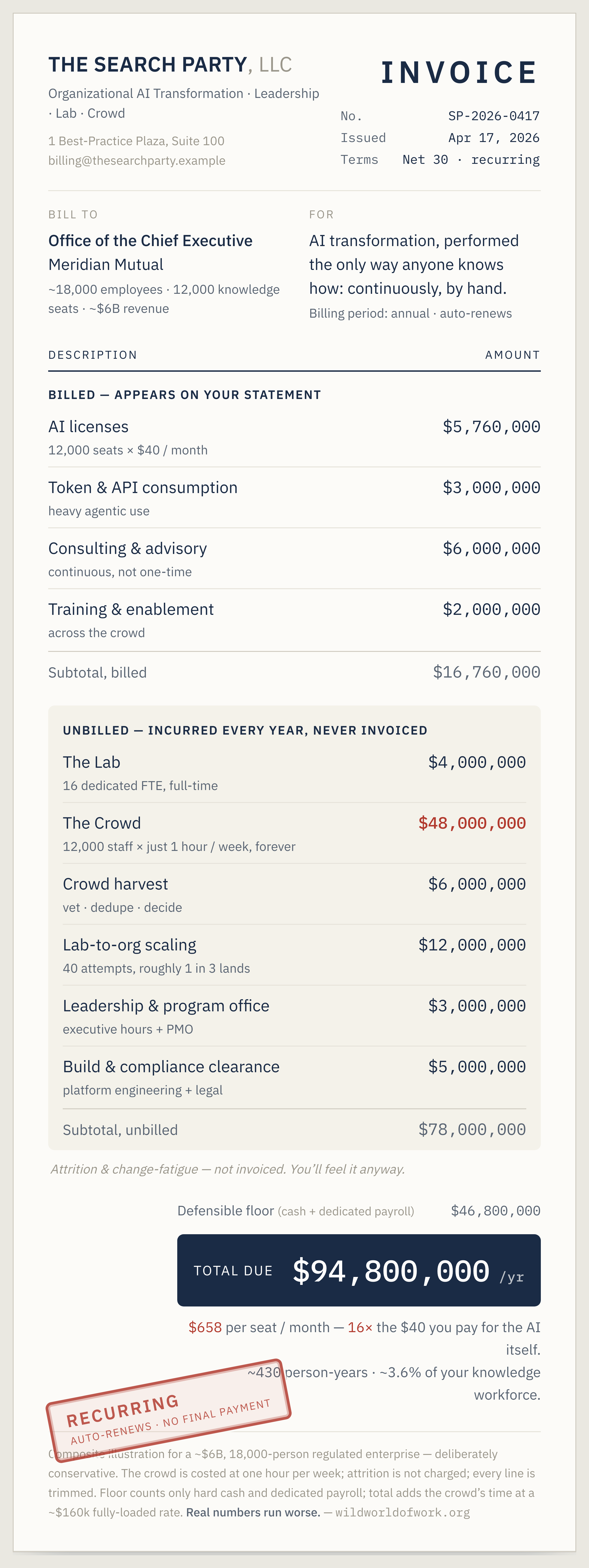
The billed items have real plans, invoices, vendors, and project plans set against them. And most of us assume that’s what this capability costs. Look for yourself at the unbilled line items and assess that for yourself. I tried to be conservative there. An hour a week per person for experimentation and that’s it? 1 in 3 ideas land in the business from your lab? Only six million in effort to harmonize the crowd’s inputs and outputs? And that’s to say nothing of the opportunity cost of all this time and cash. But even conservatively, you’re looking at 16x the cost of each license to get your organization to learn its way to whatever success looks like.
Yet nobody flinches at this effort because it’s not invoiced. It’s implemented “bottoms up” to enact this strategy for org change, and is embraced (or tolerated) because it arrives slowly. If this were 2022, that would be a smart plan, by the way. Best practice. Organizational change is hard, often doesn’t work, but you gotta try.
But AI isn’t standing still
And there’s another - far deeper - reason that we should be flinching. The CFO will probably be the one to do it, because they’re used to thinking of investments and their return. IRR (internal rate of return) or NPV (net present value) for those in the know. And after reading that realistic invoice, a savvy Meridian Mutual CFO might sit at the bar, have a couple of cocktails, do some staring, and then write:
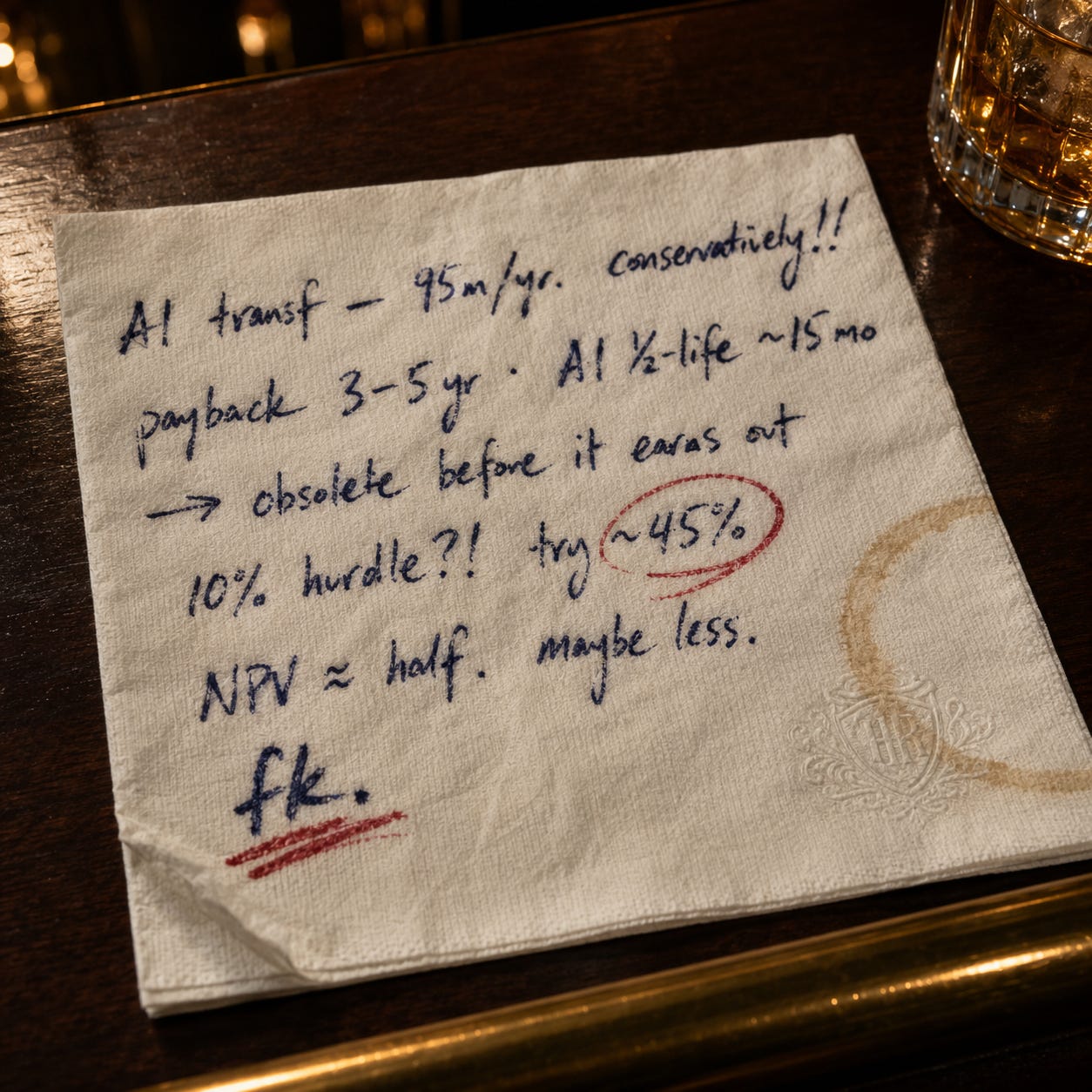
This CFO knows that the payoff from big organizational investments takes years to land and that the likelihood of success is not 100%. This is literally Erik Brynjolfsson’s “productivity J curve” in action. Even in the success case, you make lots of costly, intangible investments to change processes, roles, supporting technologies and so on, and these accrue to net-new value creation with a lag, but in the short run can appear as a negative on the value-creation balance sheet.
So a truly AI-savvy CFO would be assuming a 3-5 year payback on any new major organizational capability - in this case a “metacapability” (the ability to find and grow new AI-native capabilities). And they would know full well that payback period is starkly at odds with the clock speed of AI capability/cost curve. According to traditional logic at least, this metacapability itself will be stale by the time the org gets it spinning. Discount that payoff at the rate AI progress rots what you built - that’s closer to 45% than the 10% finance typically asks for - and the lag does the rest. The upside of this investment has to be 4.5x the spend just to break even. Thus, fk.
With a cold-eyed look at that kind of transformation math, many leaders are reaching for the one lever that requires no instrument at all. Net-new opportunities are invisible - there’s no map. And you can’t prove productivity gains - there’s no meter. But headcount? Headcount is right there in the HRIS, and cutting there pays back on a schedule a board can see. So the default AI transformation story runs exactly backwards from how it should: heads first, efficiency second (or a distant tie), invention never. Not because executives are cruel or stupid. Because cutting is the only move you can make blind.
If you know me and my work, we can actually add a dash of infirmity to the traditional insult and injury combo. You’d be paying the invoice above to make your firm more agile, yes? Practically, that takes making your people more valuable per unit of effort, which means they need new skill to accommodate new work designs and tools. But none of the above meters whether you’re getting the productivity and innovation you want at the expense of workforce development (which, these days, is really worker*AI, but in the end the human operator has to be learning and growing to surf the wave). If you’ve read The Skill Code, you know default design and use of intelligent automation will degrade skill development for a huge swathe of the working populace. And that we can get the opposite result, if we work for it. This is where the series is going - I’ll come back to it later.
The alternative, of course, is to buy a token amount of licenses and let default use rewire small parts of your organization while you skip Ethan’s plan. You’ll get far lower-cost, drift-style organizational change, and you can fast-follow, right? The question there is whether you are willing to bet the future of the firm on it. This in a way boils down to the AI-connected skill that your employees have. I’ve argued elsewhere that unless you’ve really pushed yourself to use these tools - however imperfect, and within brownfield work processes - you are not in a position to notice or pursue upside opportunities. You’ll have blinders on. In that world, your people will have less relevant skill over time, your organization will fail to notice critical strategic opportunities until they’re publicly visible, and that’s a whole lot riskier for the firm given the new clock speed for the economy. So sitting pat… doesn’t seem viable either.
So you’re damned if you do, damned if you don’t?
Thank goodness it’s 2026
No.
The dilemma is real, but it rests on an instrument (aka a set of technologies, methods, and data) that we take for granted. Find a new instrument, the dilemma dissolves.

We’ve been through this before. Take astronomy. For most of human history the smartest people alive mapped the heavens with… our eyes. Tycho Brahe built instruments like the Mural Quadrant (a quarter-circle arc 6 feet across), the Great Equatorial Armillary (a 10-foot multi-ringed sphere) to measure exact altitude of stars and track them across the night sky. He spent twenty years at this with his naked eye, and got great data. Kepler turned his measurements into laws we still use. But Tycho never saw Jupiter’s moons - not even an eagle could have, if it had happened to perch just-so in front of these devices. The naked eye could never resolve such objects. The data was up there. The instrument just wasn’t down here.
Then, the telescope: a tube of ground glass, pointed at the same sky in 1610. In his first winter with one, Galileo saw moons, mountains on the moon, the phases of Venus. New resolution, new data. Also far, far easier to get good data, far quicker, about the astronomical phenomena we’d been after before. The instrument unlocked a renaissance in astronomy and ultimately astrophysics.
So there’s a number on that napkin that’s a choice. It’s not cost. That is what it is. AI’s clock is ticking. But the lag - the time between spend and getting ROI - is only fixed because we do the work by hand. These tactics operate at a human-level clock speed: Gemba walks. Lean. Six-sigma. Grokking the org to inform your plans, earn trust, proceed, and march your way through Kotter’s model. Google Drive, Slack, Zoom. That’s not laws-of-physics level choice. It’s a laws-of-methods level choice. How long it takes to walk the building, read your email, have a group of humans learn from valuable mistakes.
So clearly the new instrument has to do with AI. But the question is what to point it at, and how? The technology is only one third of what constitutes an instrument - you need data and methods. I’ll cut to the chase here: the answers are documents you already have and the how is via a custom harness. Put together, this instrument can solve the blank-page portion of the AI transformation problem before the party starts. So you’ll build far more efficiently and get your ROI back. Party on, Wayne!
This is AI-Native Organizational Transformation - using an AI-enabled instrument for the AI transformation problem.
Let’s start with the data. A shockingly small set will do well enough for a high quality, near instant start: job descriptions and the org chart. Yes. The most humdrum documents you own. Your company has been making - and running on - these for decades. These hide a powerful well of insight about how your firm actually creates value - every role, every task, every handoff, every place a human does something. The moons of Jupiter are in there. No human can see this with the naked eye - you’d just see numerous stale, semi-accurate wordbags that get “refreshed” every year (if you’re fast), and a chart that gets broken once a quarter these days. Indeed these are the documents that people roll their eyes at. Completely understandable, given the way these docs have been interpreted and used. A strong complement to all this, zero-cost to access: data on the open web about your company, its industry, and your competitors: job postings, filings, press, product pages.
Now, on to the methods. Claude code transformed software engineering, arguably more than model quality did - at least for a time. What is the Claude Code for organizing? Claude Code doesn’t make the model smarter. It hands the model a repository and safe hands: read the whole codebase at once, hold every dependency, propose each change as a diff, run the tests before anything ships. Engineers had worked the old way for fifty years - one file at a time, from memory, with maps that rotted as fast as they were drawn. So the Claude Code for organizing starts from your repo - the JDs, the org chart, the process docs your people compile and run every morning - and gives a model safe hands for working on it: hold the whole structure at once, trace dependencies no human can, treat a reorg like a refactor. Propose the diff. Predict what it breaks and what it frees. Review before you merge. Point that at Meridian Mutual and those eye-roll documents reappear as a fine-grained, computable representation of the firm.
Point that at Meridian Mutual and you can predict patterns of default AI use, what the consequences will be, and - most importantly - how you might change the design of the organization to allow AI and human effort to flow to the right places in the right ways. None of the ingredients are secret - the science, data and techniques required for this have been on the table since at least 2023.
As for what's "right": remember the backwards default these days - heads first, efficiency second, invention rarely. A healthy firm runs in the opposite order. Net-new value first: point freed capacity at things you couldn't do before. Growth second - and not just the level of productivity, the rate at which it improves, which for people means skill development and for the firm means process and capability development. Cuts last, and only after the first two have had their run. This isn't kindness, it's arithmetic. Good people are brutally hard to find, and the ones you have hold context no new hire can buy. You marshal them toward new goals before you decide who goes. So any bona fide AI-native transformation instrument has to be built to enable the healthy order - find the invention, fund it with the capacity you free, meter the growth, and make cuts the last resort instead of the first move.
Our organizations, when this works

Meridian Mutual’s CEO rents this harness, logs in, and gets to work. He, the board, the employees and the world get to live this in a couple of years:
It’s a Tuesday, and a frontier lab shipped a new model overnight. Meridian’s map saw it coming - it began shifting two months prior based on ranked predictions: the claims-intake redesign would become worth doing, the two roles that would have to tilt their work, the handoff in underwriting that nobody would have to perform anymore. There are a couple of launch-day surprises, of course - new features and business realities mean that the hiring spec for service analysts skews relational, product development gets a speedup. The CTO reviews these proposals on a rolling basis the way her engineers review code. Here’s the change. Here’s what it frees, and where that capacity should flow. Here’s what it risks. Accept, reject, modify. New accepted changes roll out with owners and dates, and the system tracks actuals against plan the way a factory tracks production - what landed, what stalled, what surprised.
The CEO hands the model the strategy nobody outside the boardroom has seen and asks the question consultants used to bill six months for: what would we need to look like to do this? The answer comes back in an afternoon - the org under the hypothetical. Same for the acquisition target. Same for the board’s favorite question, where’s my ROI, which now has line items instead of vibes.
The CFO won’t have to drink those cocktails anymore, nor will she write that napkin. No more static asset, built over years, rotting at the speed of AI progress. Now the investment reprices itself because the map shifts ahead of each release. Changes land about when opportunity does - the lag between spend and return doesn’t shrink so much as change sign. Run the napkin again with the lag near zero and the exponent fades away: the 4.5x hurdle compresses to the ordinary cost of capital. A solid business case. And the discount rate switches sides. Every release now taxes the firms still squinting at the sky and pays the one holding the telescope. AI’s clock speed was the villain of this essay. For Meridian, it is the yield.
In this world, transformation stops being a megaproject with a kickoff and a graveyard. It becomes a standing capability: the firm holds a model of itself, the model proposes, leadership disposes. And Ethan’s leadership, lab, and crowd don’t disappear - they finally get a map worth steering with. Human attention goes where it pays: judgment, not discovery.
So let me put my scientist hat on and give you falsifiable hypotheses. If I’m right, then a well-built organizational transformation harness handed nothing but a large company’s public paperwork - job postings, the org chart as the world can reconstruct it, headcount from filings - should be able to do three things. No interviews. No workshops. Nobody walks the building.
One. Surface that firm’s top strategic priority - the one its executive team already pounds the table about - from the documents alone. If leadership would read the output and shrug, the thesis is wrong.
Two. Surface strategically-valuable moves leadership has not named. Concrete, checkable, worth real money. Not many - three would do it.
Three. Disagree with the firm - with what its documents say it is, and with what its leaders believe about how the work actually gets done. Those disagreements will be some of the most valuable things on the map.
This is not armchair speculation. In the coming weeks my team and I are going to run exactly this test on a company you’ve heard of, in public, results in this space. I’m writing the claims down now so you can hold me to them.
A flick forward, now: the full AI-native organizational transformation suite is not in this piece. Everything here - the map, the diffs, the precognition - is a prediction machine. Predictions need ground truth, and the ground truth of a firm was never in its documents. It’s in the work: the actual drafts, handoffs, and judgment calls of Tuesday afternoon. The best practitioners out there cite this as the key missing piece. A year into the effort at Trail of Bits, Dan Guido said the data about how people actually work with AI piles up on each person’s device, that he’d love to collect and synthesize it to improve the whole system - “and we don’t have a solution there yet.” That’s the full ruler. It’s taken two years to build our version.
The worker has something to say about all this, too. You can’t marshal good people toward new goals without them seeing that they’re growing into them - the map finds potential inventions, but something else has to meter the growth. I said we have to track actuals the way a factory tracks production. If that phrase was chilling, we’ll probably get along. Almost all systems ever built to measure work served the person watching. AI-native organizational transformation only works - as engineering and as ethics - if the instrument also serves the person being watched. Am I getting better or worse with AI, and at what? There isn’t a worker alive who doesn’t want that answer, and there’s never been a ruler that gave it to them instead of their boss. That’s the “twice” in measure twice. Next post, I build the ruler the worker holds.
PS - we’re heads-down deploying with a handful of companies through the fall, so I’m not taking new ones. The waitlist is real, though, and your JDs and org chart are enough to hold a place in it. You know where to find me.
I agree with the idea of using AI to help understand and redesign the organization. I’m less convinced by starting from org charts and job descriptions.
Those describe how the company is supposed to work (often badly and often years out of date), not how it actually does. And they may have little connection to current strategy.
For me, the more interesting sequence is: understand how the environment is changing → make strategic choices → redesign the work and organization around them. Otherwise AI risks optimizing the company we already have.
I find your blog extremely frustrating.
I read your book, and it was a revelation. Genuinely an essential read in the AI age. When I read your blog and occasionally decipher insights from your writing, they are usually uniquely and usefu.
But dear God, can you make your writing a bit clearer? Your pieces read like a stream of consciousness. You pack sentences with too many twists and turns, and so many quirky turns of phrase that it becomes really hard to follow you.
For this post, I literally had to have Claude rewrite it and then read the Claude version. Obviously suboptimal.